I’ve written a lot about why we plant cover crops and what the benefits are but how do we assess those benefits? Today I thought I would share with you how I make observations on my farm to see if cover crops are working (hint: they are!). Cover crops have an important role to play on our farm and I can’t even begin to describe how delightful it is to see a field of green cover crops in late October/early November when everything else is dying back and being plowed under.
If I had a superpower I think it would be attention to detail especially as it relates to growing plants. I notice patterns in the color of crops, how the soil looks around and underneath the crops, how it reacts to different tools and so much more. These patterns inform my decision making and help me better understand what’s going on with my plants.
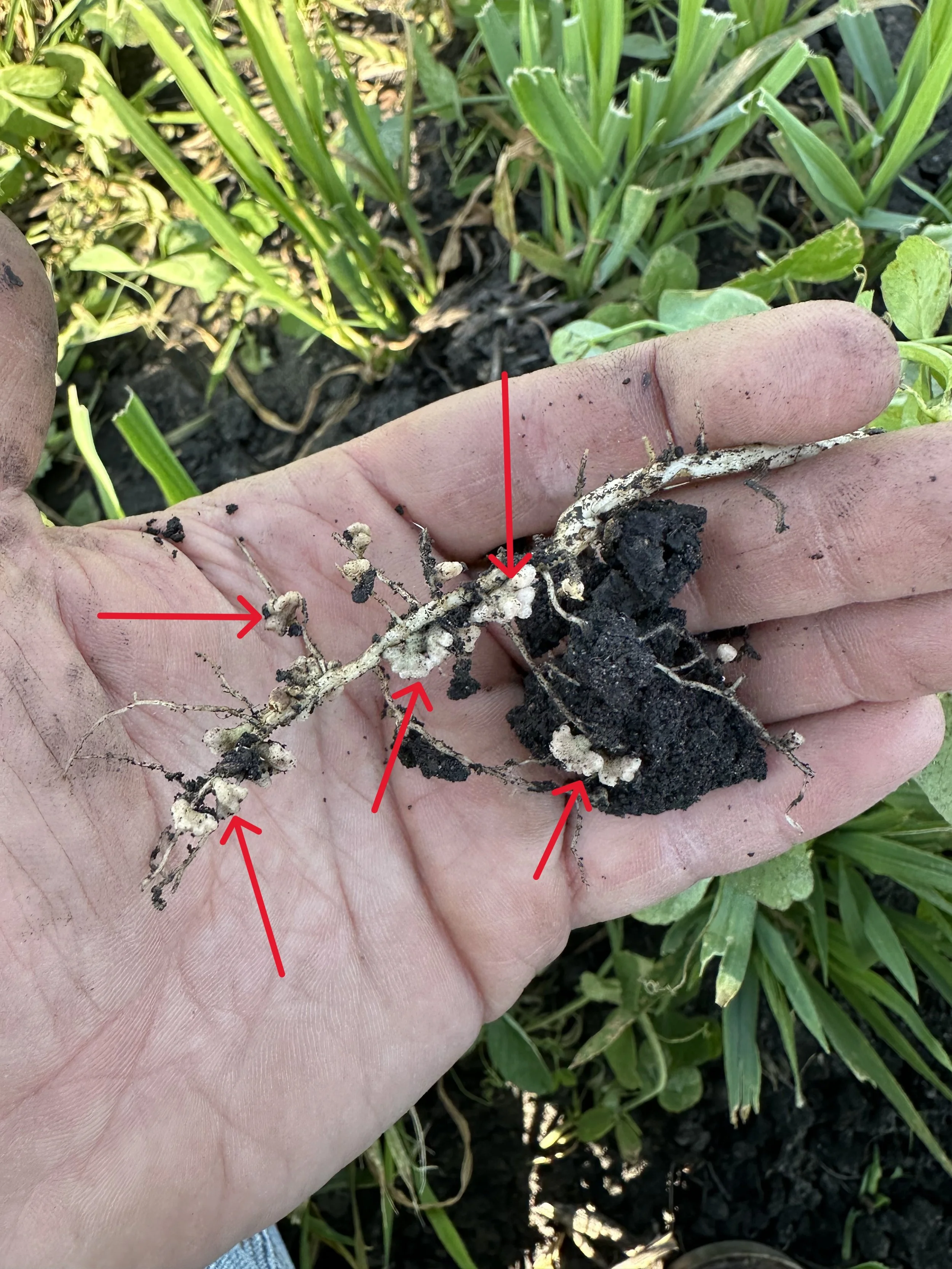
One really neat observation I made recently was noticing how many Rhizobium nodules were on the peas that are part of our cover crop mix. See the photo below, red arrows point to the Rhizobium nodules. These nodules house beneficial bacteria of legumes (peas, beans, etc), and pull atmospheric nitrogen from the air for use by the plant. We call this nitrogen fixing. Nitrogen is a critical nutrient for plants and the more of these nodules you have the more nitrogen the cover crop is pulling from the air and putting into my soil. As you can see in the photo below there are a bunch of nodules on the peas! That means next years drop will have more nitrogen available and I should need less fertilizer!
One other technical bit of information here: many companies sell innoculants that one would use to innoculate seeds for bacteria strains that would do this job. We typically don’t purchase or use innoculants. Why? Because our soil already has the beneficial bacteria present to form these nodules! That’s one indicator that we have healthy soil!