The Flood of 26
This week we’re going to do a bit of a deep dive (hah!) into the flooding that happened about 10 days ago. We’ll go through what happened, how much rain we got, the impact on the crops, and the silver linings.
On Friday September 18th into the early morning hours of Saturday our area received a highly localized and intense rainfall event. Rain totals reported from across the southern part of Waseca County range from 6” - 9” or more and it came fast. Most of that rain fell in just a few hours. This caused significant and highly localized flooding that affected us, nearly all farms in the area, and especially New Richland, MN where up to 80% of the homes in the small town had at least some water damage.
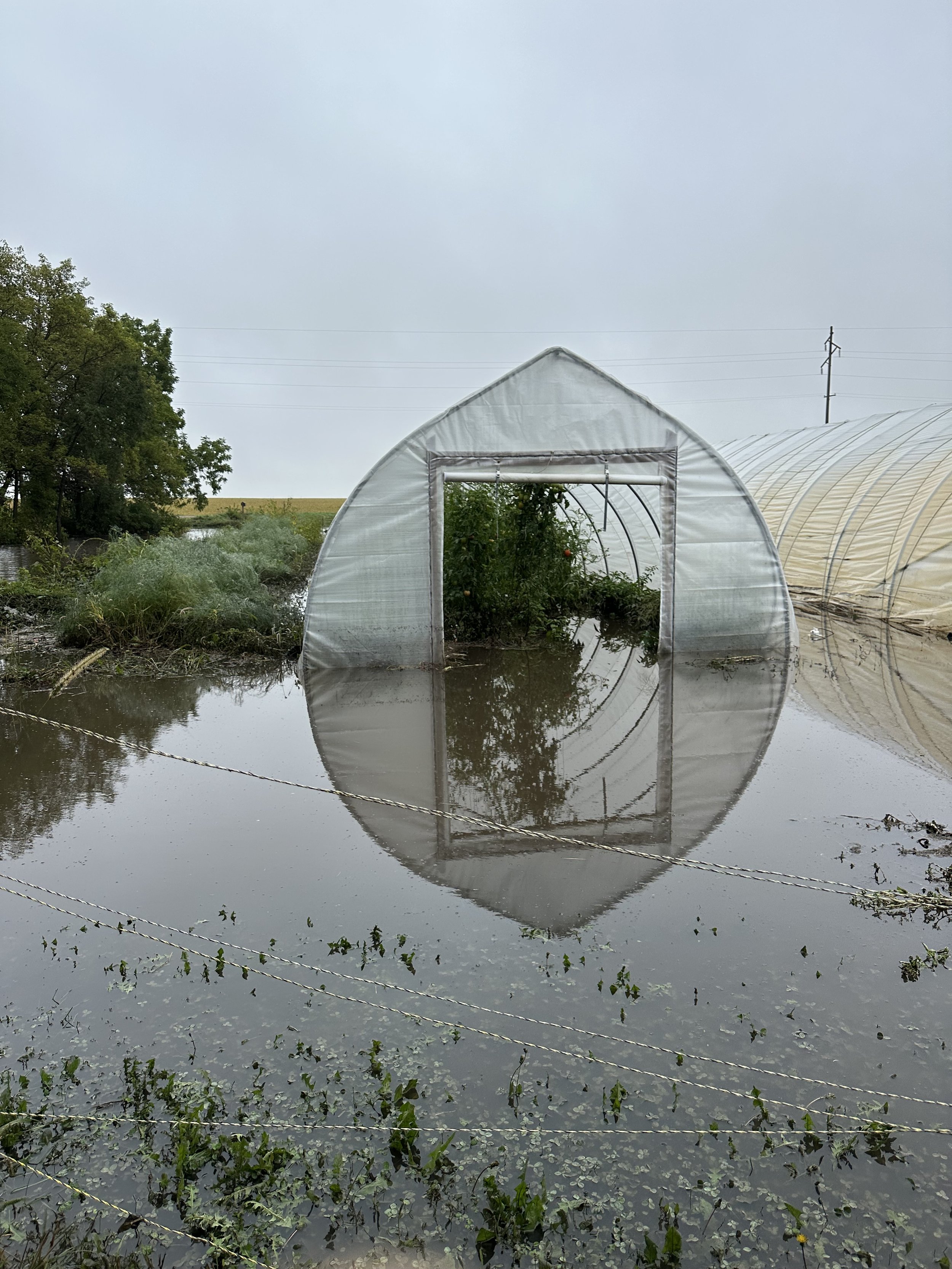
For us, the flooding was extreme. I’ve never seen this much water on our farm, even when we had the significant flooding in 2024. A few examples that help illustrate how much worse this flood was. First, the water was up over our driveway and about 1’ deep across our driveway. In 2024, the water never got high enough to cross our driveway. Second, ALL of our tunnels had a minimum of 8” of water in them and up to about 3’ of water. A few more inches deep and our last transplants of the year would have floated down the Little Cobb Creek. In 2024, only one of our 5 tunnels was affected with flooding. We’ve never experienced anything like this before.
The flood waters did recede quite rapidly. By Sunday morning the water had receded from all tunnels and all outdoor beds and into only the lowest portion of our farm where we had planted the waterway cover crop mix. But the damage was done. Unfortunately, any produce that comes into contact with standing flood waters is considered contaminated and cannot be sold. This is because it’s hard to know what is in the flood waters - there could be sewage or more likely, runoff from the many nearby confinement barns that could contaminate the crops. We lost around 80% of our fall lettuce crop. Other losses include basil, tunnel peppers, celery and some tomatoes. We estimate the dollar value of crops lost to be around $7500.
There are other negative implications as well. First, is our winter crops. We are in the midst of planting our winter season crops into our new winter tunnel. Timing is critical for these crops because we run out of daylight and warmth very fast. We are about 1 week behind schedule with only about 1 more week left to plant before it’s too late. If these crops don’t mature in time, then we won’t have them available for harvest in winter. This could cost us up to another $7500 or more. Also, we have a large crop of carrots out in the field. While they were not flooded, the soil is VERY wet and we are not drying out very quickly at all. The carrots are at risk of rotting in the field because of wet conditions if we don’t dry out soon. If we lose our storage carrots that is another $5000 loss. These crop losses can add up quickly. We don’t think we will lose all of the carrots or all of the winter crops but we might see some lower yields on both depending on how things go.
I’ve painted a pretty depressing picture so far so let’s end this on a high note. What are the silver linings in this situation? I think the first silver lining is just how awesome our local food lover community is. So many people have stepped up and given us the support we need to keep going. It’s so remarkable and Lara and I are SO grateful.
Another silver lining is just really seeing and understanding how powerful our cover crops can be. Our cover crops, though small, kept our soil in place despite extreme rainfall, water washing across the farm, and super hydrated soils. It’s just astonishing to see how well they actually worked in this situation.
A technical silver lining that is just a hypothesis. We think the flooding will improve soil health inside our tunnels. Our tunnels are watered with well water that is quite hard with many dissolved minerals in the water (just ask our water softener and iron curtain). Because of this, salts and alkalinity build up in our soil over time causing the soil pH to raise. This can adversely affect plants causing lower yields. Rain water is typically slightly acidic and can help “flush” the salts out of our soil. If my hypothesis is correct, we could see lower pH and salt readings on our next soil test. Time will tell!
Finally, there are many crops that were spared and an error on my part will allow us to have lettuce again in a couple weeks. Crops that avoided flood waters include tomatoes, peppers, winter squash, kale, broccoli, cabbage, radish, cilantro, scallions, spinach, popcorn, salad turnips & more. And the farmer error I made means we have lettuce that was planted in high ground instead of the tunnels so we will have lettuce in mid to late October.
So, that’s the flood recap. It’s been a tough week but because of support from our community and the diversity of crops we grow on our farm we will press on!