Recap: Lobbyist for A Day
I’m back from my trip to Washington D.C. to help the Minnesota Farmers Union lobby for policies that benefit farmers and rural America. Politics has been a touchy subject for quite some time and I’m guessing this blog post might stir up some feelings or opinions and even disagreements. I’m hoping to write from a place of fact or at least facts as I understand them. Feel free to disagree with me and the Minnesota Farmers Union about what policy priorities for farmers and rural America should be. In fact, I’d love to hear your take because I bet I can learn something from you!
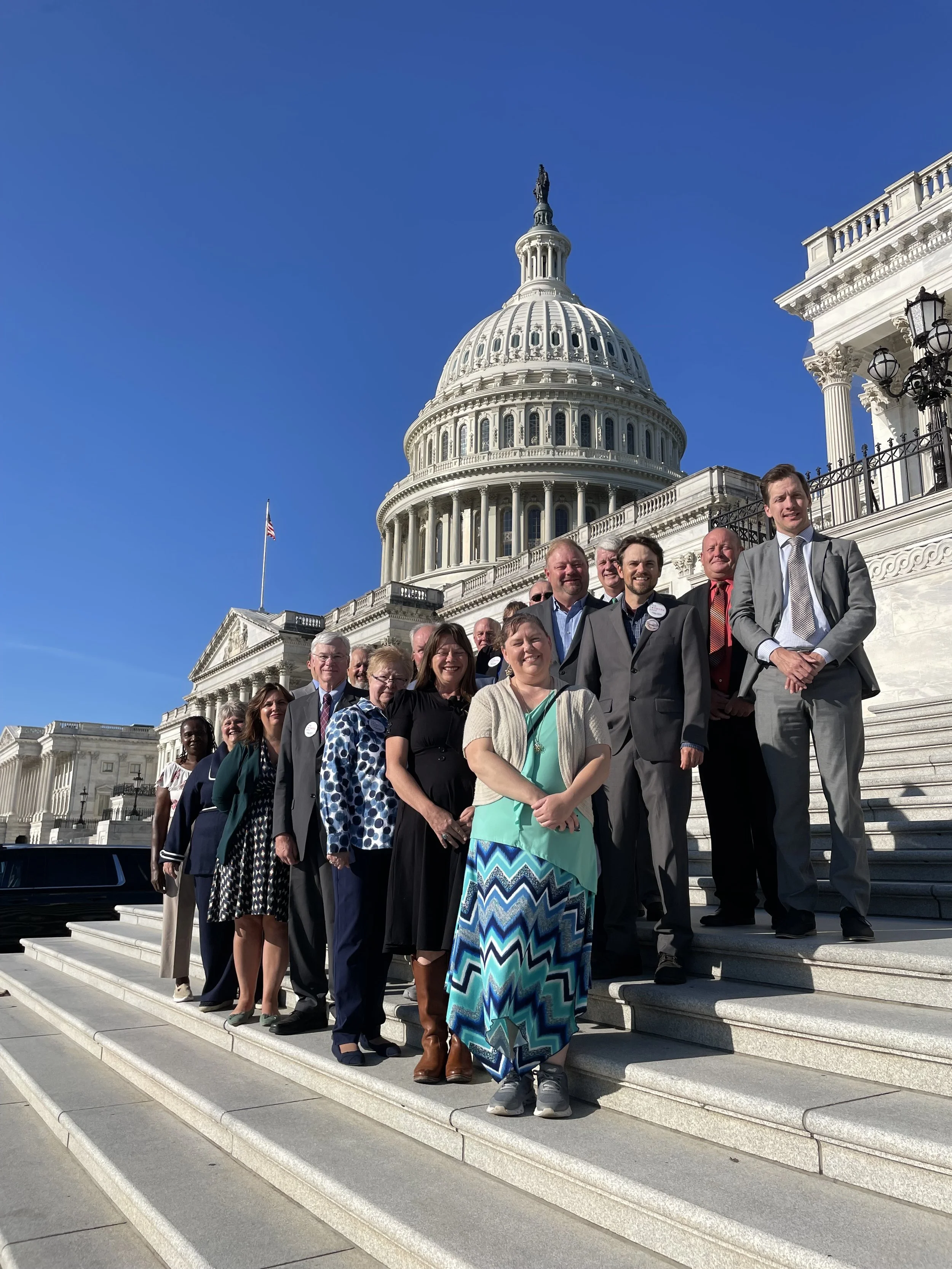
I went as part of the Minnesota delegation for the Minnesota Farmers Union which is part of the larger National Farmers Union. Their slogan is “for farmers sake” but really it should be “for everyone's sake”. After all, the slogan “Agriculture is the foundation of manufacture and commerce” was one of the first things I saw as I entered the USDA building. Without agriculture cities aren’t possible and we’d all be back to hunter-gatherers.
I’ll summarize the main policy priorities we had briefly below:
Restore Local Food Procurement Programs. The now defunded Local Foods Purchase Assistant program was incredibly popular across the country and even across political ideology. We advocate for a house and senate bill introduced with bi-partisan support to restore funding for a replacement program.
Break Up Corporate Ag Monopolies. Did you know that just 4 companies control something like 80% of all beef, pork and poultry processed in this country? They disguise this by selling their products under different brand names and different labels giving the illusion of choice.
Pass A Farm Bill. The Farm Bill is a collection of programs that benefit farmers, rural communities and folks experiencing food insecurity. The farm bill includes things like SNAP (food stamps), crop insurance and conservation programs.
Tariffs/Trade Policy. End blanket tariffs.
Biofuels. Expand use of ethanol and biodiesel with a nationwide E15 program.
Meat Labeling. Country of origin labeling for meat. Not everything labeled “product of USA” is an animal that was grown or raised in the USA.
Before I get into my take on these policy priorities and reflections I wanted to just say that the Minnesota Farmers Union delegation I was a part of was a diverse mix of growers. There were several vegetable growers, livestock producers, cut flower producers and more. That’s something I really like about farmers union: we’re a diverse mix of growers advocating for farm policies that work for all farmers.
We met with either the congressional members themselves or their staffers and in some cases both. I personally met senators Amy Klobuchar and Tina Smith as well as representatives Angie Craig, Kelly Morrison, and Betty McCollum. I also met with a staffer from representative Brad Finstad who is my representative here in district 1. Our group also split up so we could meet with staffers from Ilhan Omar, Tom Emmer and Michelle Fischbach’s offices respectively.
Here are my take-aways from the meetings. First, the meetings are so short and so brief that it’s really hard to dive into the nuance and details of various policy issues. Democratic representatives seemed largely supportive of our overall policies priorities while Republican representatives were more muted in their responses. Reading between the lines we know Republican representatives see the problem brewing in the rural economy but they were very hesitant to offer up solutions.
Another takeaway is that it seems there is bi-partisan support for enacting a Local Foods Procurement Program similar to the Local Foods Purchasing Assistance Program that was canceled under the Trump administration. There are currently bi-partisan bills in both the house and the senate that would re-create this program.
A third takeaway is that both Republicans and Democrats recognize the problem tariffs have created for farmers. The problem boils down to this: China buys basically 1 out of every 3 rows of soybeans produced in the United States. Further, China buys a large amount of pork (which is fed crushed soybeans) from the United States. Usually, by this time of year contracts are signed for China to buy a certain amount of soybeans but this year there are no contracts. Soybean prices, and most commodity prices in general are depressed.
Democrats see this as a self-inflicted wound while Republicans are both hopeful a better trade deal will come and also recognize that a single buyer, China, buying that large of a percentage of U.S. commodities is a weakness and that we should diversify our exports. I think both are right, it's just too bad it’s coming at the farmers profit.
Both Republicans and Democrats are skeptical that a farm bill will be passed by the end of the year. Tina Smith described the farm bill as the “grand bargain” where democrats who support strong social safety nets through the SNAP program and republicans who support a strong farmer safety net could come together to pass a bi-partisan bill. The problem is that Republicans drastically cut SNAP benefits in the One Big Beautiful Bill Act without Democrat support through the reconciliation process. Both Representative Angie Craig who is ranking member on the House Ag Committee and Amy Klobuchar who’s on the Senate Ag Committee foresee difficulty getting democratic support for a farm bill because democrats will be unwilling to vote on anything that doesn’t restore SNAP benefits. Likewise, some republicans will be unwilling to vote on a farm bill that includes SNAP benefits due to budget concerns.
My own view is that it was either incredibly short sighted for Republicans to vote to cut SNAP and expect to pass a farm bill in the future OR that Republicans really don’t care about passing a farm bill. Given the muted response overall from Republican staffers it seems to me that this whole farm economy is designed to bankrupt the small commodity farmers. The big will get bigger and the small will whither.
Our farm, Cedar Crate Farm, is lucky. We are not reliant on government programs like subsidized crop insurance or direct payments from the government. We can’t be forced out of the market by low commodity prices, a lack of an adequate farm bill (which really doesn’t do much for us), or slow government payments. Despite direct marketing being significantly more work we largely operate outside the government agricultural system which gives us a good bit of resilience when it comes to poor trade policy and congressional infighting. One tidbit I picked up that I find interesting is that a commodity farmer that was on the fly-in with me shared that about 25% of their gross farm income comes from direct government payments. And remember, that doesn’t include crop insurance premium subsidies.
The last thing I’ll hit on is bio fuels. My initial reaction is that biofuels are not the best idea ever. It seems like we as a country are over producing commodities and trying to drum up new ways to use these commodities by subsidizing new markets. If gallon for gallon ethanol and gasoline were equal it might be a different story but my own experience is that I see a 10-30% reduction in mileage in my vehicle when I use the highest ethanol blend my vehicle supports. I do see how a gallon of ethanol is more environmentally friendly than a gallon of gasoline since there’s some amount of carbon that’s offset in the production of ethanol. That said, the biofuel issue is not a hill I would die on and if it helps my neighbors then it is something we might as well do.
I walk away from this fly-in and my experience in Washington D.C. with a mix of feelings. First, I feel a little more patriotic than before not only being in DC but also participating directly in the democratic process at the federal level. It’s hard to be in DC and not feel patriotic. Conversely, I feel pessimistic about Democrats and Republicans coming together to work on policies that benefit farmers and rural America. I feel proud that my farm is able to function without government support. I feel jealous that commodity producers get so much government support. The experience was intense and intimidating but I learned so much. I’m grateful for the opportunity and was glad I had a chance to make my voice heard.
Lobbyist For A Day
About a month ago I was invited by the Minnesota Farmers Union to attend their fall “fly in” event where I will join farmers from across our state and across the country too to lobby for farm and rural policy in Washington D.C. It’s a busy time of year for our family with back to school, the farm still producing in full swing and the seasons changing but I couldn’t pass up this opportunity. It’s not everyday you get an invite to potentially meet with your congressional delegation to advocate for yourself.
In the prep call that the Minnesota Farmers Union held they emphasized telling a personal story as it relates to farm policy. There’s a lot of federal farm policy that doesn’t support farms like mine. Most of the money, most of the programs, and most of the investment in farming goes to corporations, large corporate farms, and commodity farms (in that order). One of the few programs that helped and benefited not only farms like mine but our community more broadly was the Local Foods Purchasing Assistance (LFPA) program. Essentially, you can think of it as the Federal Government subsidizing local food production in a similar way to how commodities like corn and soybeans are subsidized.
Sadly, LFPA was canceled with the new administration which we talked about and described earlier this spring. I understand that tucked into the new farm bill is a version of LFPA which I intend to encourage my representatives to support. Not only does LFPA benefit farms like mine but it also benefits businesses that purchase goods from our farm to process into ready to eat meals for a variety of people including children and food insecure folks. Further, LFPA really helped us last season when we experienced catastrophic flooding and hail. It allowed us a market outlet for our seconds and produce that wasn’t fit for our market stand or CSA boxes giving us a much needed source of income when many of our crops were flooded out or damaged.
I’m looking forward to the opportunity to share my story, our farms story, and the impact these programs can have on our community. I look forward to writing the follow-up blog to let you all know how it went!

Why Farm Fresh, Local Produce Tastes Better
Or why grocery store produce doesn’t taste good.
When I started Cedar Crate Farm back in 2015 I had one distinct problem that I wanted to solve for people. The problem is that grocery store produce doesn’t taste good. I knew that because I had grown up eating produce fresh from my mom’s large garden. I knew what fresh produce was supposed to taste like. I knew that the grocery store was selling an inferior product. I knew that I could grow better tasting produce and share it with this community in south central Minnesota.
Why Grocery Store Produce Doesn’t Taste Good
The reasons for that are many but we’ll go over a few of the key reasons briefly here. The first reason that grocery store produce doesn’t taste good is that the produce varieties that grocery stores carry are varieties selected for their ability to withstand shipping and shelf life. This is almost always at the expense of flavor.
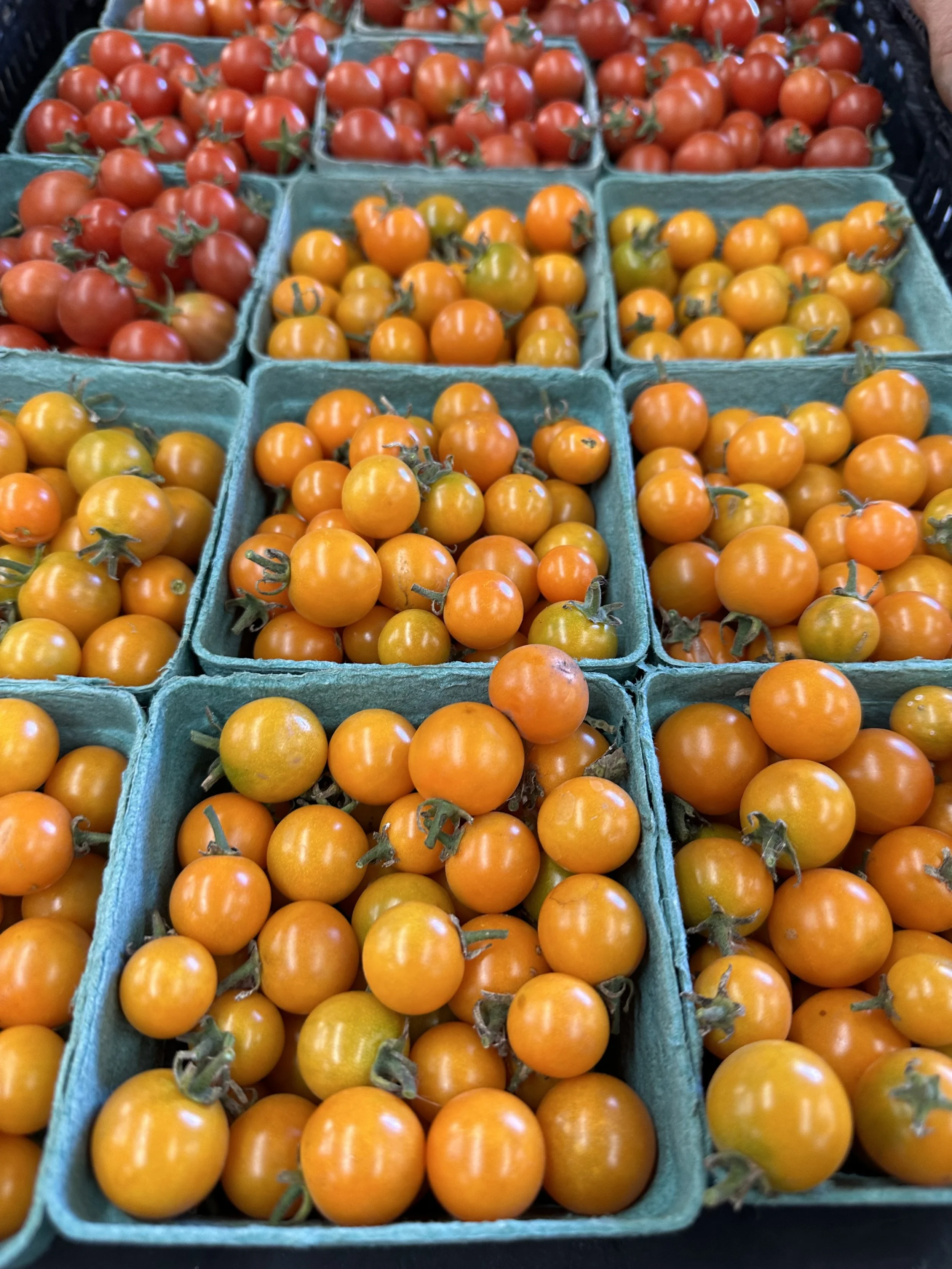
Take our incredibly delicious and incredibly popular Sungold cherry tomato. It’s known for it’s incredible sweet flavor that’s almost like candy. It’s also known for it’s propensity to crack during shipping. Because of it’s propensity to crack you’ll never find it in any grocery store but you will find it in your CSA shares, our online farm store, and our farmers market stand.
The second reason grocery store produce doesn’t taste good is because it isn’t fresh. Most produce in most grocery stores (even some food co-ops!!) isn’t local. It isn’t even grown in the Midwest and in some cases isn’t even grown in this country. If you think about the steps the produce takes it could be a week or more since that produce was harvested and when it ends up on your table. Here’s what it might look like:
Produce is harvested and spends time on the farms harvest, wash & pack line. 1-2 days.
Produce is shipped to a distribution center. 1-2 days.
Produce is shipped again to the grocery store. 1-2 days.
Produce is in the grocery stores receiving area/walk-in cooler. 1-2 days.
Produce sits on the grocery store shelf until it spoils or you buy it. 1 - ??? days.
Best case scenario is the produce is 5 days old when you purchase it from the grocery store but probably a lot longer. No wonder it doesn’t taste good!!
Our farm solves this problem by growing the best tasting varieties of produce we can find! Further, we always harvest, wash & pack your produce the day before we deliver ensuring you always have the freshest, best tasting produce possible!
How We Dig Carrots
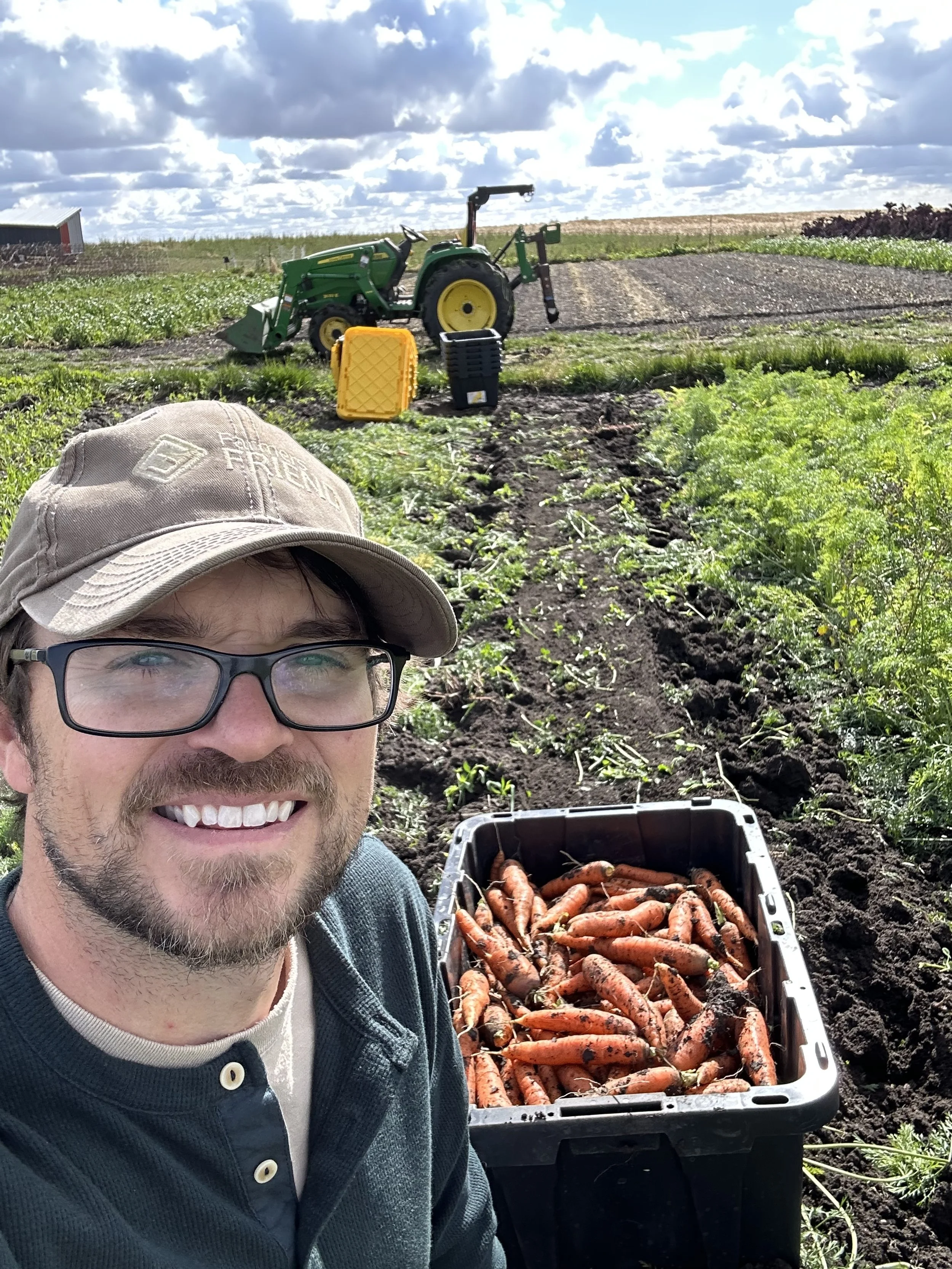
Carrots are one of our most important crops on our farm and something we’re known for. Each year we grow literally thousands of pounds of carrots for our CSA members, online store, farmers market & whole sale partners. When you’re digging that many carrots every season you need a better, faster and easier way to dig carrots than a simple shovel, broadfork or potato fork. We use a tractor attachment called a bed lifter to make digging our carrots much easier.
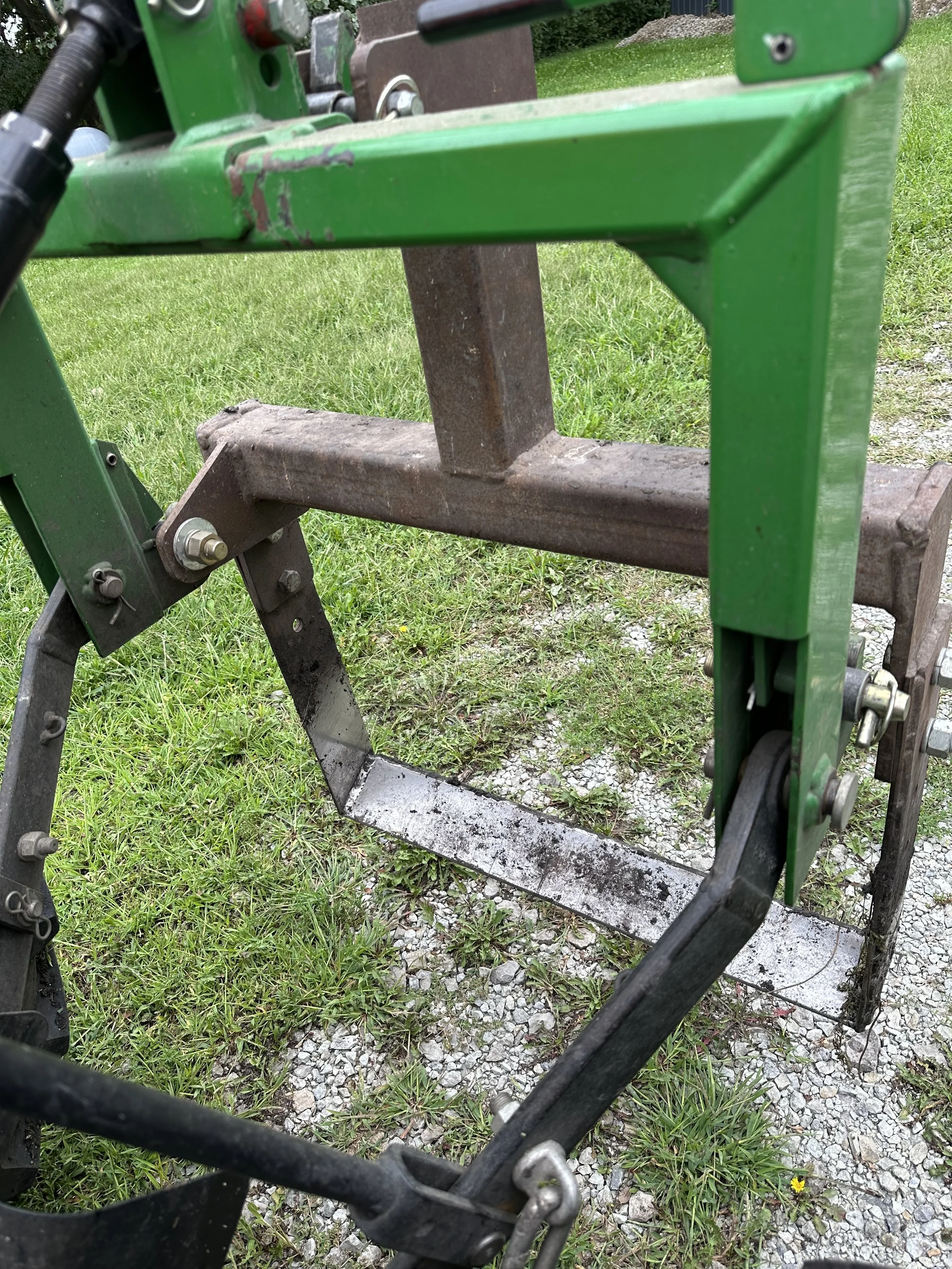
The bed lifter is a simple tool overall. It works by digging underneath the depth of the carrots and loosening the soil. This enables us to easily pull the carrots out by their tops for harvest. It greatly increases the amount of carrots we can dig and it’s a lot easier on our backs as well.
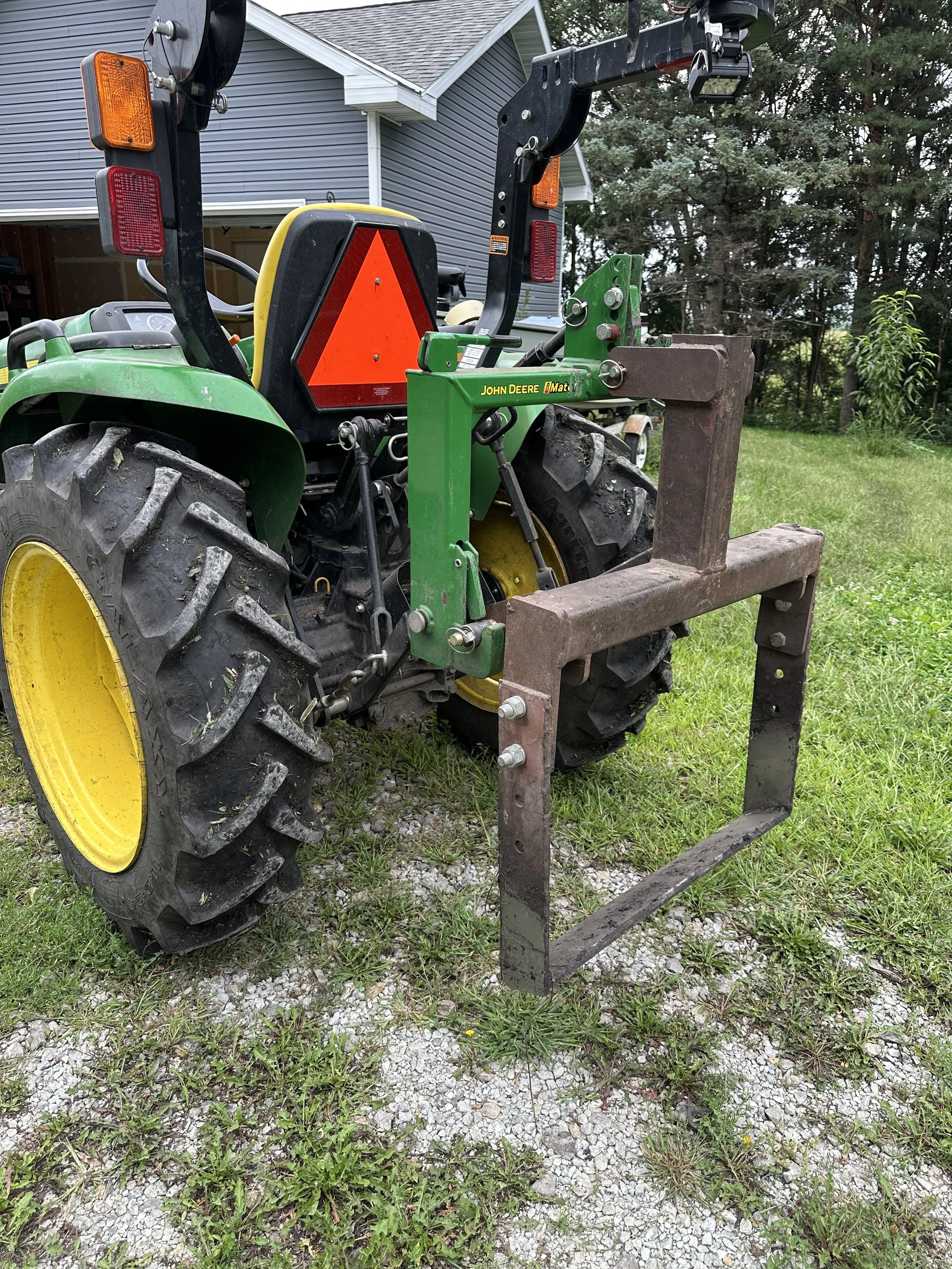
There are a couple tricks to using the bed lifter. It needs to be deep enough that we don’t slice off the bottoms of the carrots but not so deep that the carrot cling to tons of dirt and mud. The angle of the cross bar at the bottom needs to be gentle enough to not break the carrots but steep enough to loosen the soil. And the soil conditions need to be right. If it’s too dry the soil breaks apart in huge clods breaking carrots and not greatly improving the speed. Conversely, if it’s too wet we aren’t able to use the bed lifter because we’d either get the tractor stuck or not have enough traction to pull the bed lifter.
Why Cover Crops Are Important
Farming in a sustainable and earth friendly manner is one of our primary farming values on our farm. We seek to not only maintain but improve the land we farm on over time. In the grand scheme of things, the time we spend farming this land is pretty small and we want the next generation of farmers to be able to succeed. Not only that but we also want to protect the soil, air and water so that our farming footprint stays confined to the acres we farm. One of the key ways we work towards this goal is by planting cover crops. Today we’ll go over why cover crops are important and what cover crops we plant on our farm.
First, we should define what a cover crop is. For us, a cover crop is a crop that we plant whose primary purpose is to improve our land. Further, a cover crop is not planted with intent to harvest and sell a product.
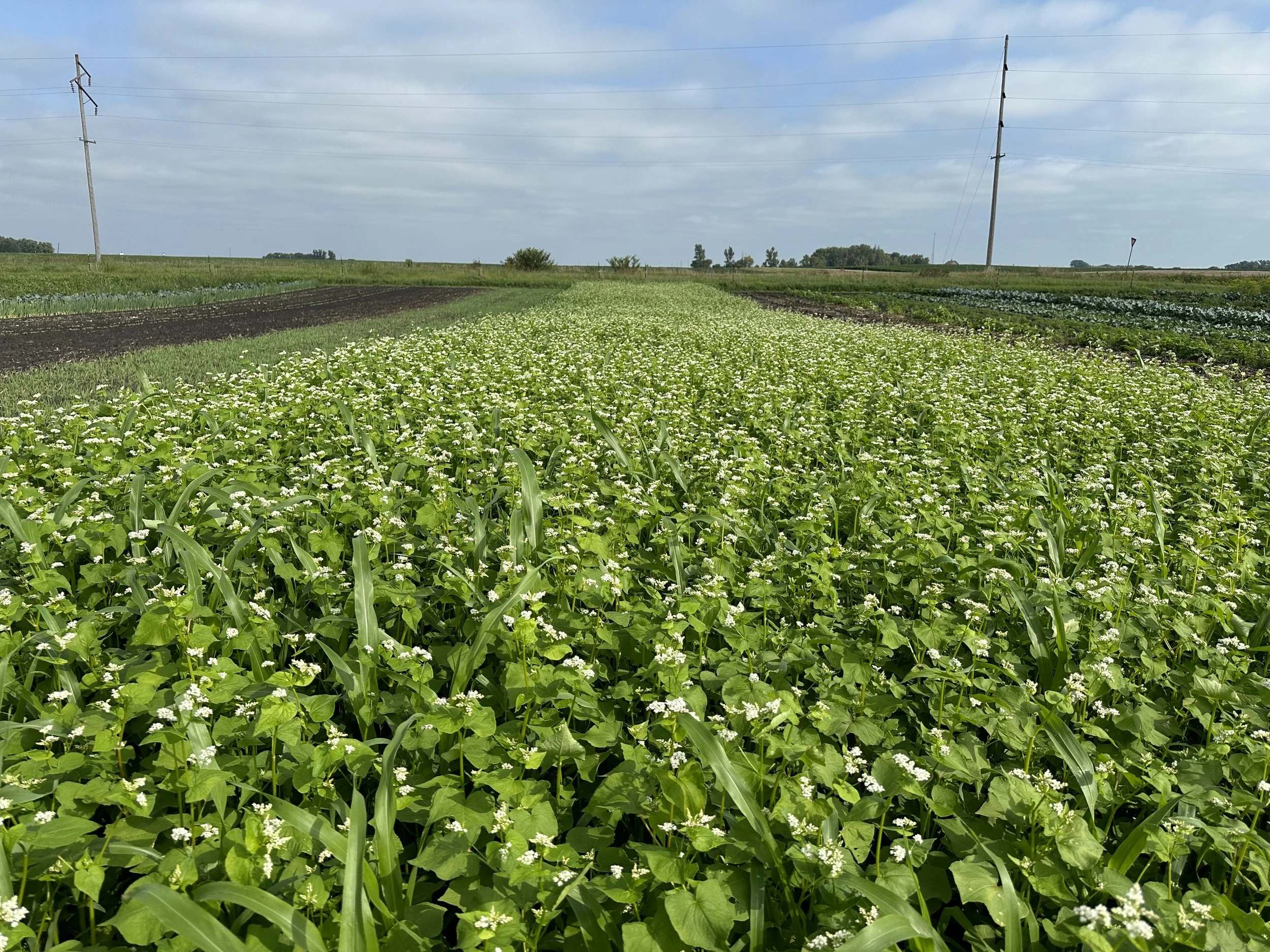
Our summer cover crop mix. The plants with white flowers are buckwheat. The long slender leaves that resemble corn are millet.
Cover crops serve a variety of purposes on our farms and many farms in general. Their benefits include reducing soil erosion, suppressing weed growth, providing habitat for beneficial insects, and improving soil health. Our primary goals for our cover crop mixes are to suppress weed growth and improve soil health. That’s not to say the other benefits are not important - they are. It’s just that when we look at which cover crops to plant we are seeking to achieve those goals primarily and the other benefits secondarily.
We have two mixes of cover crops that we use on our farm to achieve the goals of improving soil health and suppressing weeds. In summer we plant a summer mix of cover crops. That is, crops that grow well in the heat of the summer. This mix includes species like buckwheat, soy beans, sun hemp, sun flowers, millet & more. In the fall we plant a mix of peas, oats & phacelia. These crops grow better in the cooler temperatures of fall and can grow later into the season than our summer mix. Our winter mix is capable of withstanding frosts.
To suppress weeds we seed our cover crops pretty densely and lightly incorporate the cover crop seeds into the soil. With a little rain the cover crop comes to life creating a thick mat of vegetation that crowds out weeds. In our experience, we’ve observed that the areas where we plant cover crops are generally much easier to weed the following season.
Cover crops improve soil health in a few primary ways. First, some cover crops like peas can pull nitrogen (a primary plant nutrient) out of the air and store it in the soil for future crops to use. Cover crops in general also contribute to soil organic matter which microorganisms in the soil feed on. These micro organisms then metabolize the cover crops and leave behind nutrients future crops can use.
Many of our cover crops also achieve our secondary goals of reducing soil erosion and providing beneficial insect habitat. Because we’re planting pretty densely and minimizing fallow ground by using cover crops we are reducing soil erosion. Additionally, buckwheat - one of our primary summer cover crops - flowers quickly and the bees love it. Buckwheat provides habitat and forage for the bees!
Cover crops are an important part of sustainability on our farm. We’re always looking for new species and new mixes of cover crops to help improve our soil and improve our farm!
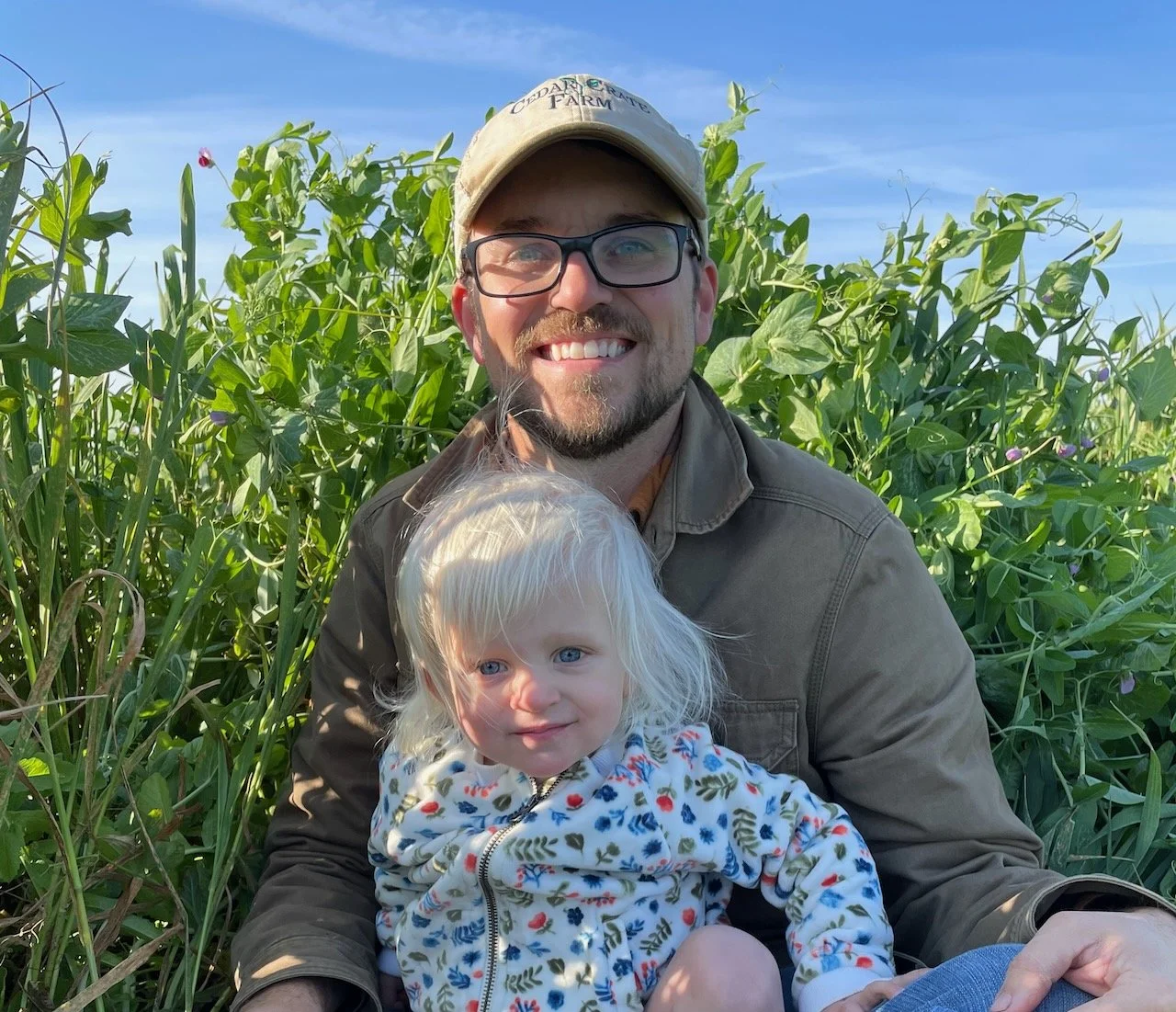
Addie (about 2yrs old) and I sitting in our oats & peas cover crop mix!
Our New Vacuum Seeder
We made a large new purchase for the farm recently: a new electric vacuum seeder. This purchase is a huge upgrade for us and today we’ll go through exactly what a vacuum seeder is, how it’s different from the seeders we currently use and the crops we plant to use the vacuum seeder on.
What is a vacuum seeder?
A vacuum seeder uses suction with air to hold the seeds to a plate. The plate rotates based on spacing needs and the vacuum is cut when the plate rotates to the position where the seed is supposed to be dropped into it’s furrow. Our particular vacuum seeder has a multitude of different plates with different spacing and hole sizes to accommodate a wide variety of seeds.
Vacuum seeders have much better seed singulation. That is, making sure a single seed is dropped at the designated spacing instead of a multitude of seeds. That’s because the suction of the air holding the seeds against the plate is easier than trying to have a single hole size that fits a the variability that comes with seeds. Not all seeds are the same size even within the exact same crop and variety!
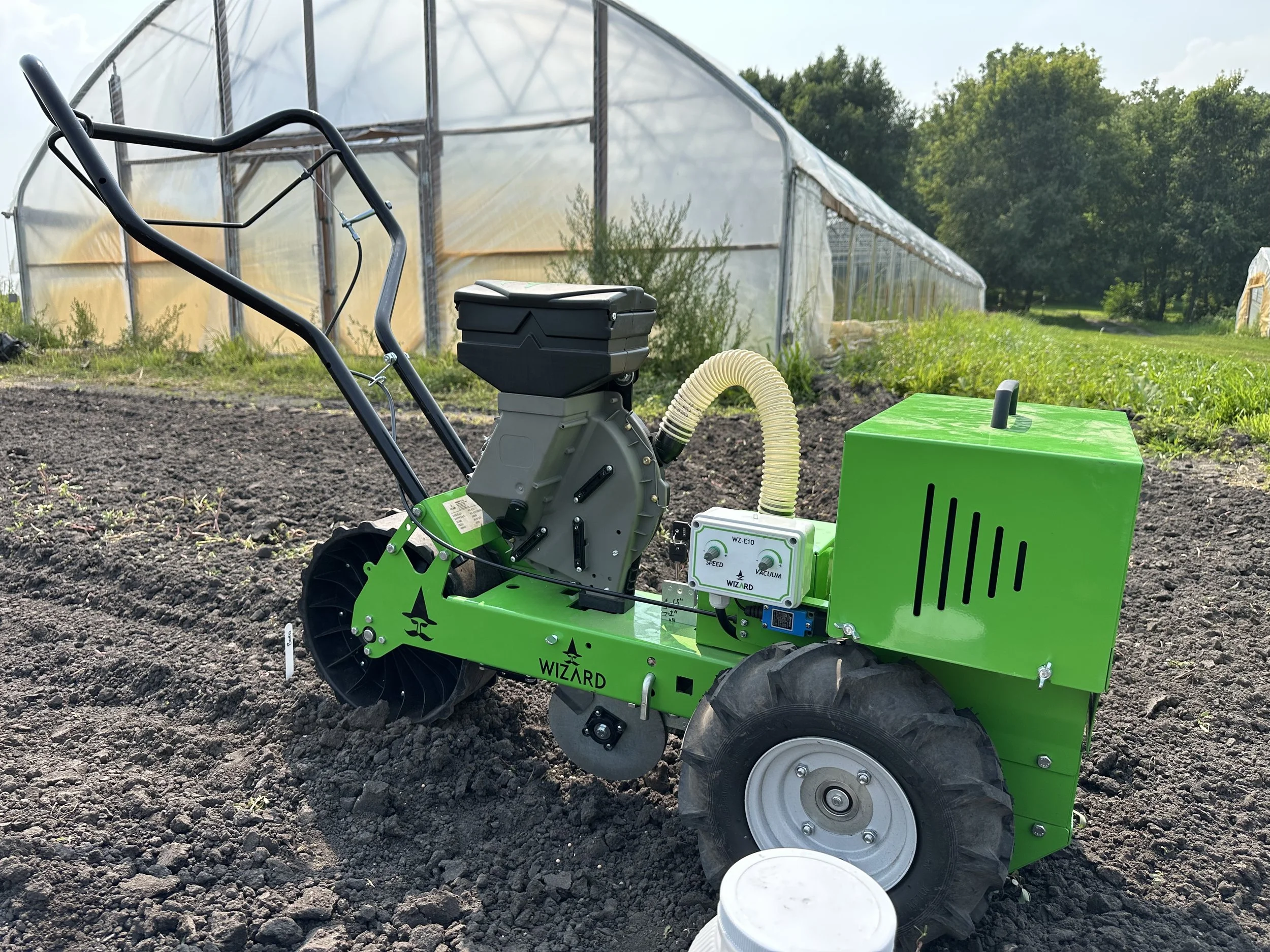
Our new vacuum seeder! First crop seeded with it was beets.
How are other seeder types different?
Our other seeders, the Jang and Hoss seeders both work similarly. Each have a seed plate or seed puck that has holes drilled into it for different seed sizes and spacing. Instead of air suction through vacuum holding the seeds in the plate/puck only gravity allows the seed to fill the hole. Because the holes need to accommodate the variability in seed sizes even within crops you inevitable end up either jamming seeds or dropping more seeds than necessary.
Which crops will we plant with the vacuum seeder?
One of the things we love about the vacuum seeder we bought is that it can be used for a number of different crops. We plan to use it to seed peas, green beans, popcorn, sweet corn, beets, cucumbers, zucchini, summer squash & melons.
In particular I’ve been very frustrated with our Hoss seeder in our popcorn & sweet corn. The Hoss is just not accurate enough to singulate seeds nor does it achieve the desired spacing. We end up with lots of doubles, triples or gaps which is a problem because we’re either spending labor thinning doubles and triples or spending labor weeding gaps where there are no crops. The vacuum seeder will solve these problems for us!
Garlic Harvest 2025
One big project we checked off the list this week was completing our garlic harvest. Not only is it a pretty big job but also it’s somewhat time sensitive. Leave the garlic out in the field too long and the cloves can start to split apart which negatively affects shelf life.

A grimace for the weeds. You can see at least part of a row of garlic over my left shoulder though. :-/
Overall, we’re happy with our garlic harvest this season. It’s not our biggest and best crop ever and our weed management could have been better but what we pulled up looks nice and tastes amazing. When you consider that our seed stock was grown last year in what was some of the worst weather we’ve ever seen and then add to that a pretty wet 2025 the harvest we got is exceptional. Intense rainfall for two seasons and we’re still getting a good harvest. We’re proud of that.
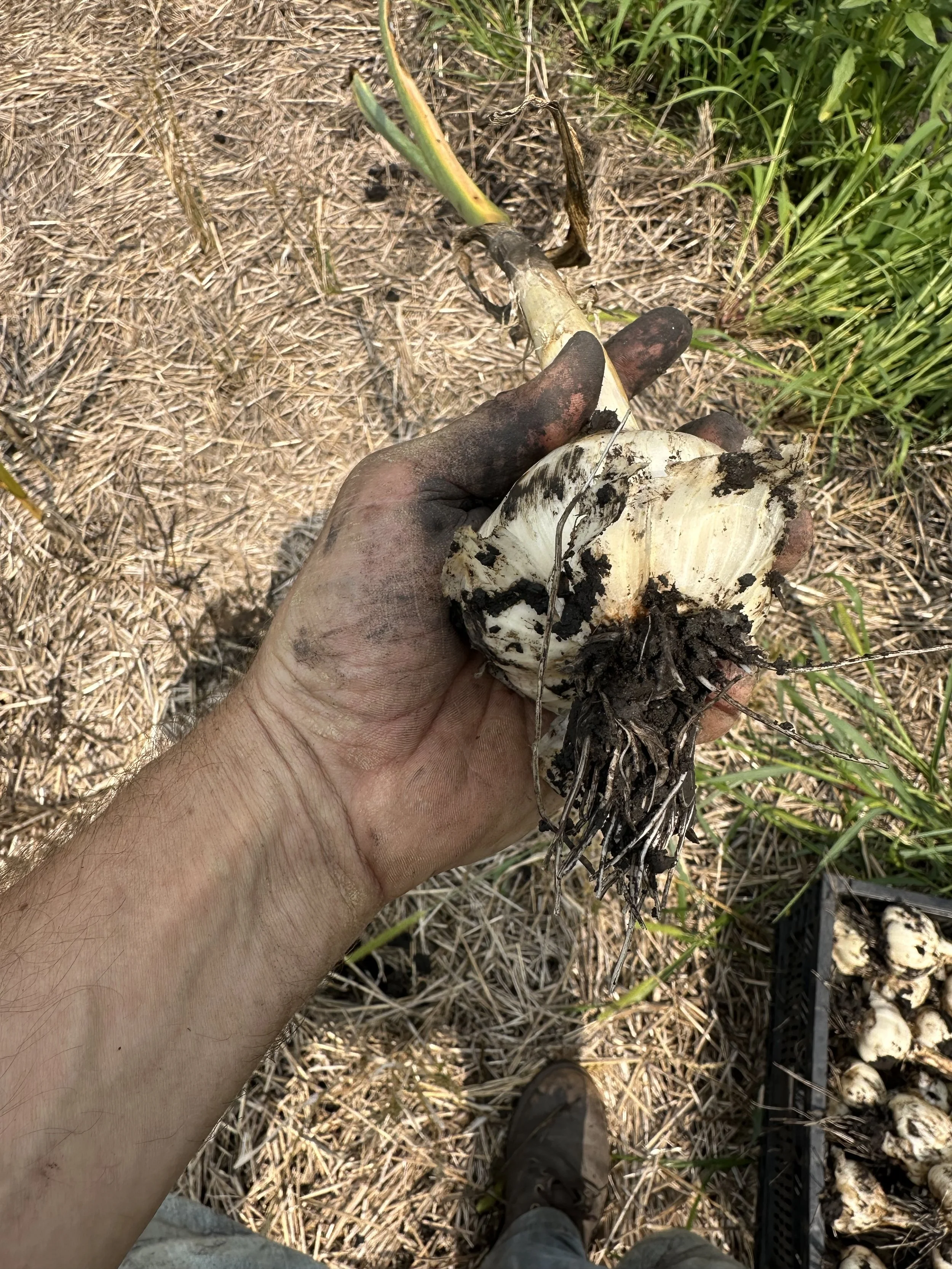
Pretty good sized garlic bulbs but they seem smaller on average than previous years.
In previous years we’ve used a tool pulled by our tractor called a bed lifter dig underneath the garlic and loosen the soil so we can pull the garlic up easily. We use this tool on our carrots too. But this year we had two problems using that tool. First, the weeds got out of control in our garlic patch so we couldn’t see the rows from the tractor seat. The second problem was that our rows were spaced just a little too far apart. We ended up damaging a few garlic bulbs when we attempted to use the bed lifted.
What did we do instead? Luckily the soil was both damp enough and loose enough that we were able to pull up the garlic by hand without too much effort. Don’t get me wrong, it was difficult and harder than using the lifter but it was doable. We had a very small percentage where the stem broke leaving the garlic bulb in the ground. It might seem like this is a big bummer but there’s a really good chance the garlic bulbs left in the ground will regrow next season for early spring “green garlic.”
Now we wait about 2 weeks for the garlic to cure. That is, dry down the out layers that will form a protective seal and greatly improve shelf life of the garlic. Once curing is complete we’ll have plenty of garlic for CSA members, online orders and our farmers market stand!
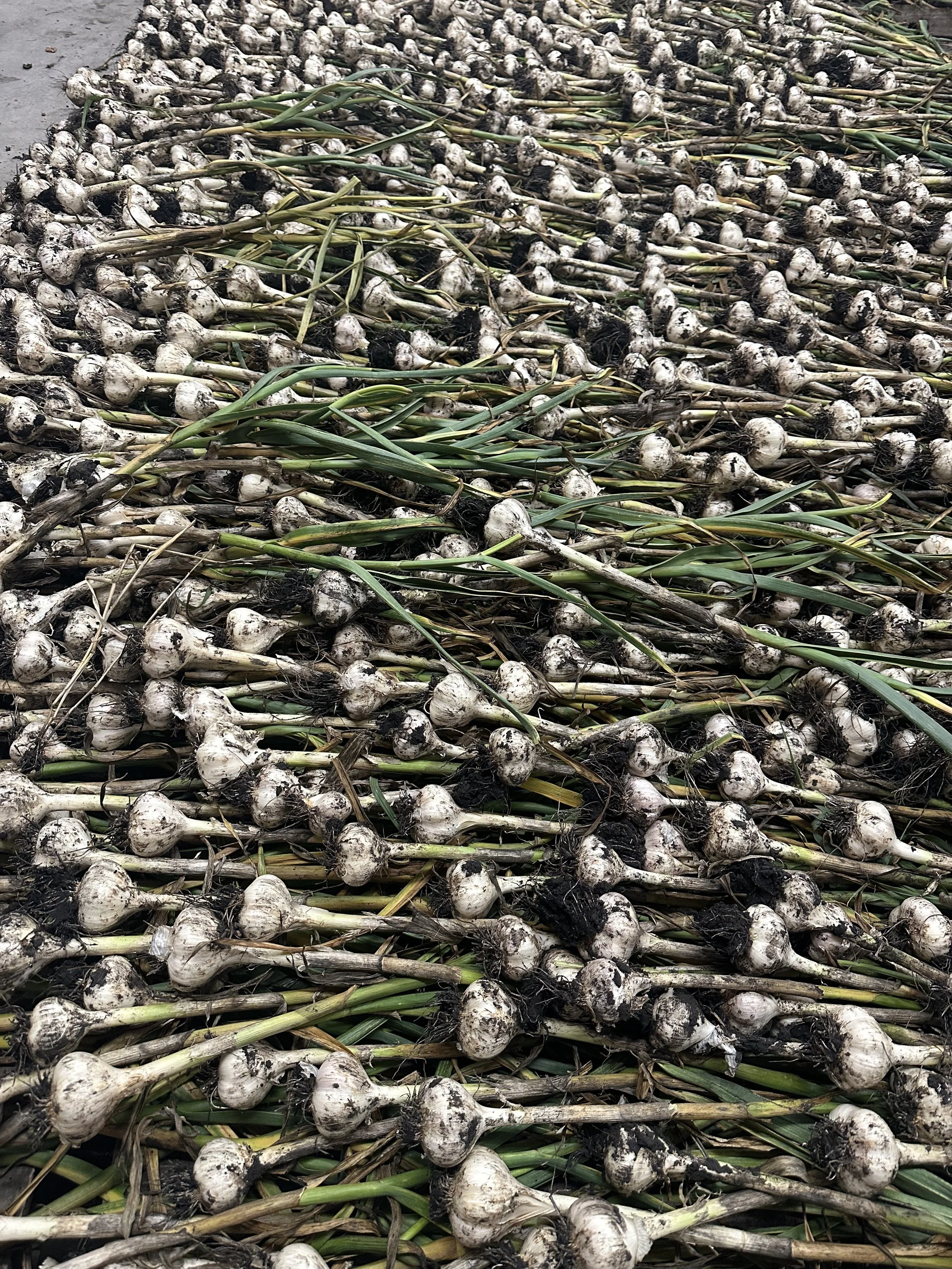
Garlic set up to cure!
Farm Flooding: It Takes a Village
The wet summer continues.
I read a book this winter called The Stoic Challenge by William B. Irvine. The book, while brief, gives pointers on how to deal with adversity. To boil it down to a central idea The Stoic Challenge challenges readers to take every problem or setback they face and frame it as a challenge by “the stoic gods.” The goal, is to not let setbacks ruin your mood or your day. The way we choose to frame setbacks determines our reality.
I’m glad I read that book because two summers in a row of intense rainfall, difficult farming conditions, and high disease pressure put my basic stoicism skills to the test. I can’t say I’ve dealt with everything this summer perfectly - the way The Stoic Challenge advises - but I think I’m doing better than last season.
One last bit of context before we get to the flooding: I left on a vacation for the Boundary Waters Canoe Area Wilderness (BWCA) last Friday, July 18th. In the BWCA there’s no internet, no cell service, and no way to communicate back home. It’s a perfect way for me to stop fretting about the weather, emails, product inventory and everything else technology related. On Tuesday, July 22nd I got back to civilization and promptly checked my messages, email and the weather. Not good.
On Friday evening I saw a huge spot on the radar right over our farm. I knew it was raining hard but I didn’t know how much. I later found out we got about 3.5” of rain in about 2 hours. Our farm is already overly saturated from the frequent heavy rains this season has brought so that wasn’t welcome news. On top of that, I had just planted our fall storage carrots - one of our most important winter crops. Carrots do not like heavy rainfall just after planting.
Then, on Wednesday evening we got a second round of nearly 4” of rain in about 2 hours. Over 7” of rain in less than one week. Not good. Both rainfalls prompted a community response here on the farm. One of our tunnels flooded and it holds one of our most important summer crops: lettuce. With how saturated everything is we knew that we needed to remove that water as fast as possible.
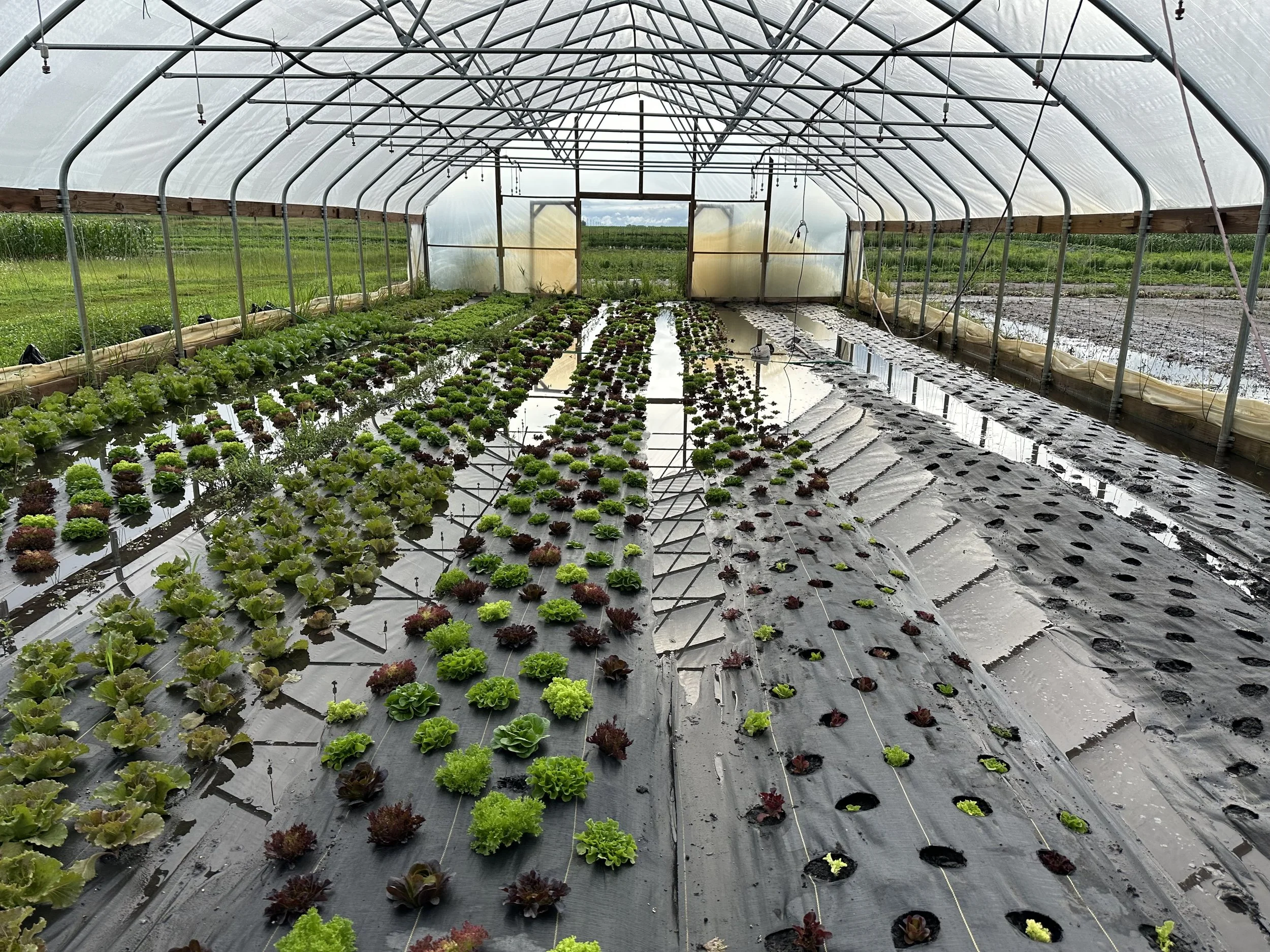
The lettuce tunnel on Thursday morning. So. Much. Water.
Lara - who did an amazing job while I was away - arranged with our neighbors to borrow a pump on Sunday. Huge thanks to the Millers who not only loaned the pump but also helped get it set up and more. The pump worked beautifully removing all the standing water from the tunnel in just a few hours - likely saving our summer lettuce. Of course, the tunnel flooded again on Wednesday evening so Thursday we did the same thing.
We still don’t know if we saved all of the lettuce yet. Time will tell if our lettuce succumbs to disease before it reaches maturity. We do know we vastly improved our odds.
Here’s hoping for a dry August!
Shallots: A New-To-Us Crop
I’ve been farming professionally for 11 years and gardening my whole life (I’m almost 40) and I’ve never grown shallots. That is, until this year. Most years, we try out a new crop or two and after 11 years and all the things I’ve grown throughout my life the list of things we don’t grow that people ask about is getting small. Shallots were the one thing we still routinely get asked about and so we finally gave them a try this year. Here’s how we tackled this new to us crop.
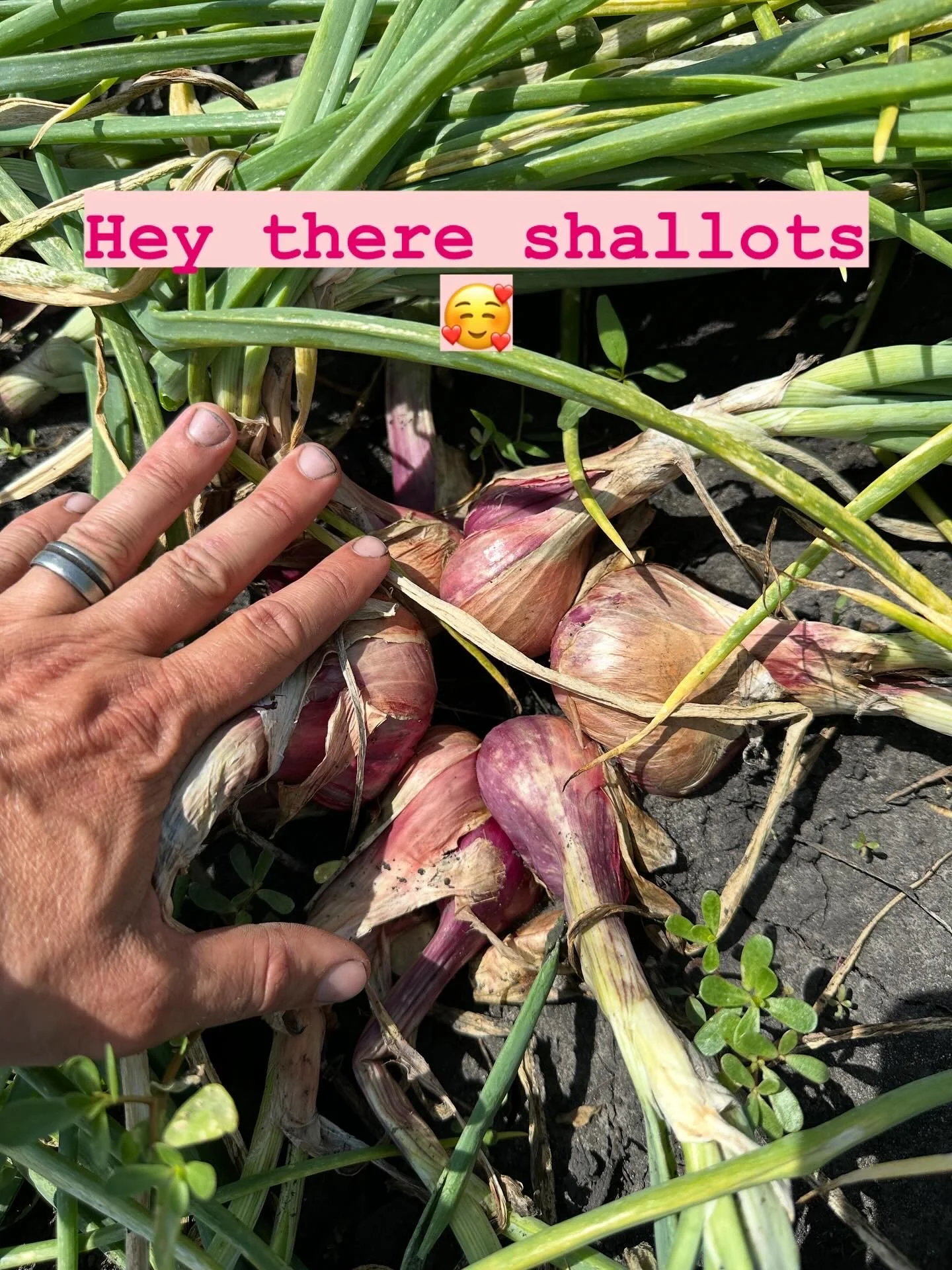
They’re so pretty! Good size on them too.
We ordered shallot sets from the nearby Albert Lea Seed House. Sets is the term used to describe very small bulbs of shallots (or onions) intended to be planted and grown. I saw a lot of conflicting information about whether to grow plants or sets. We chose to grow sets because we didn’t have the greenhouse space and I couldn’t find a supplier that would mail live plants as we do with our onions. I also saw conflicting information about whether to plant in the spring or fall and mulch them like garlic. Since I decided to plant them over the winter my hand was forced there.
We kept up with the weeds as we try to do with all our other crops and almost 3 months later we’re nearing our first shallot harvest. The advice we saw online says to treat them as we do storage onions: when the tops fall over it’s time to harvest and cure them. Curing simply means allowing the outer skin to dry down and form a protective layer allowing for a much longer shelf life.
We’ll plan to harvest these shallots in the next week or so and after around 2 weeks of curing our very first shallot crop will be ready for you!
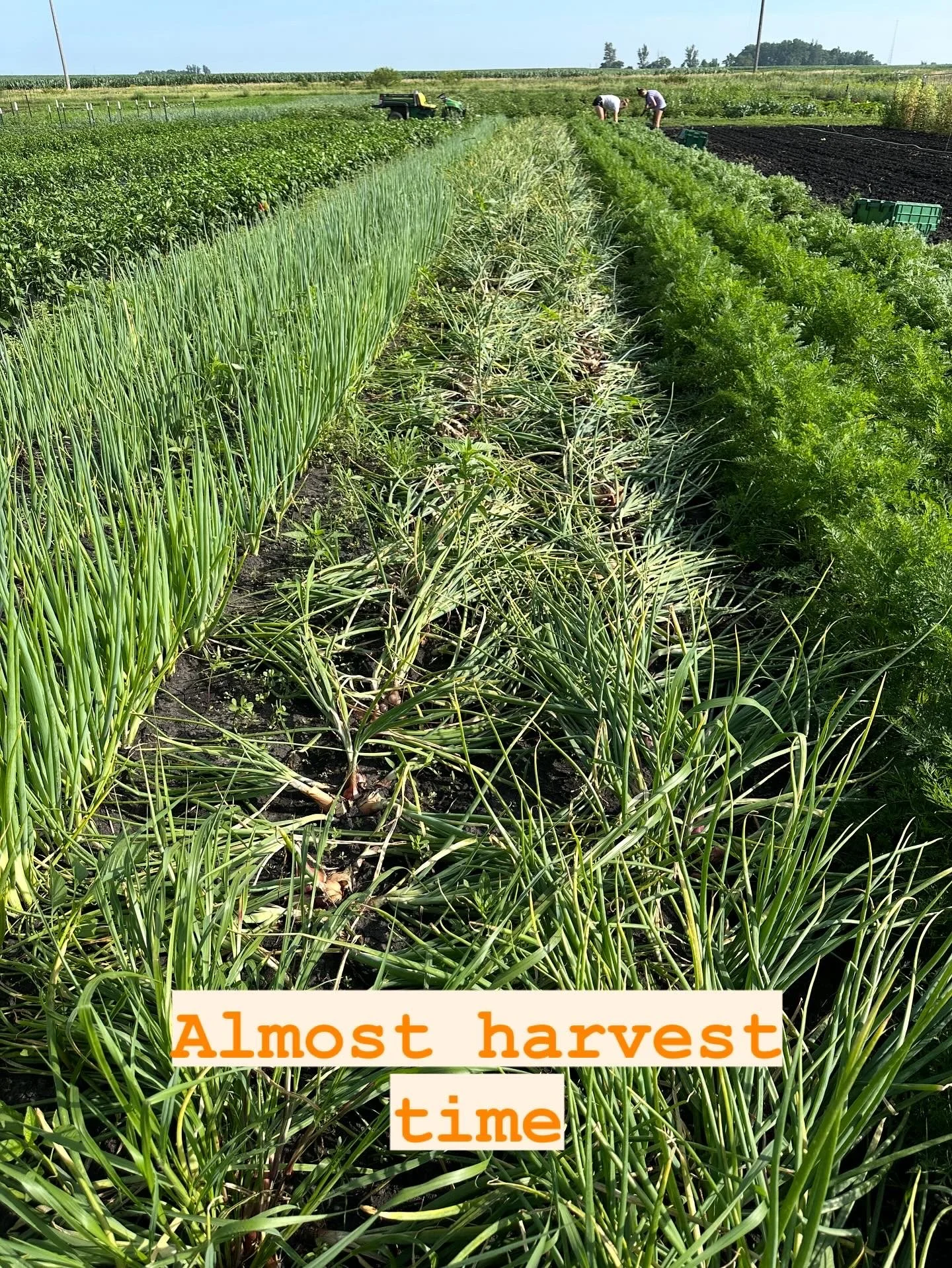
Shallot tops have fallen over - that’s how we know it’s close to harvest time.

What the shallots looked like before the tops fell over.
The Tomato Tunnel
Tomato season is juuuuuust about here! In fact, I picked the very first tomato of the season just yesterday and promptly ate it. Farmers treat :-). This week I wanted to share a few photos of our tomato tunnel and talk about our pruning and trellising strategy both of which are very important to getting a good harvest of delicious, healthy, summery tomatoes.


We prune and trellis our tomatoes for a number of reasons that all help us with our goal of harvesting lots of large tomatoes from healthy plants for the duration of the season. Let’s talk about pruning first. When we prune tomatoes we’re pruning two things: lower leaves and “suckers.” We prune lower leaves from the plant to help improve airflow in our tunnel which helps reduce the risk of disease in our tomato tunnel. We prune suckers to both encourage the plant to produce larger tomatoes and to make the plants more manageable.
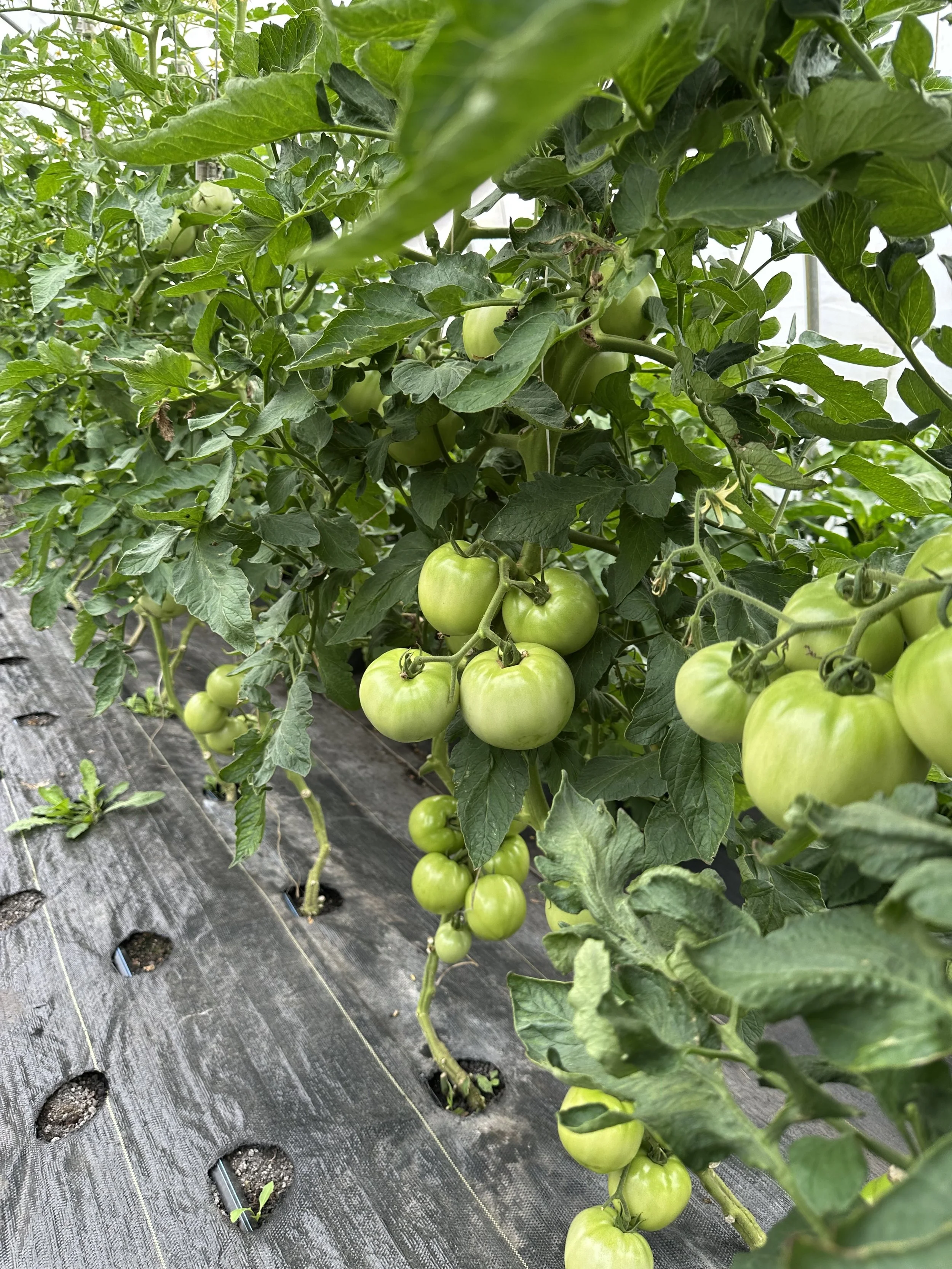
This years tunnel tomato crop. We’re very happy with the fruit set on these plants.
We’re trying the new-to-us QLIPR system for practicing the lower and lean tomato trellis system. The idea is that the growing season is long enough and that our tomato grow tall enough that we run out of vertical space in our tunnel. Because of this, we need a way to manage that height and lower the plants down and leaning them to one side or another allows us to easily manage that height.
QLIPR is unique in that it utilized two clips that leap frog each other on our weekly prune and trellis system. It also allows us to do all of our tomato management (pruning, leaning, harvesting) from the ground instead of a ladder.

Each plant gets a wire hook and two foam lined clips. The clips move along the vine as it grows allow us to keep the “business end” of the tomato at chest height. Clips can be seen on the far top right of this photo.
Tomato management has become one of my favorite things on the farm and tomatoes continue to be a very important crop on the farm. We hope to expand our tomato offerings in future years including growing some of our cherry tomatoes using this system as well as adding other heirloom tomatoes.